Nobody Liked Mrs. Wagner
Today we remember her fondly
The gray plastic chairs were cold, hard and unforgiving.
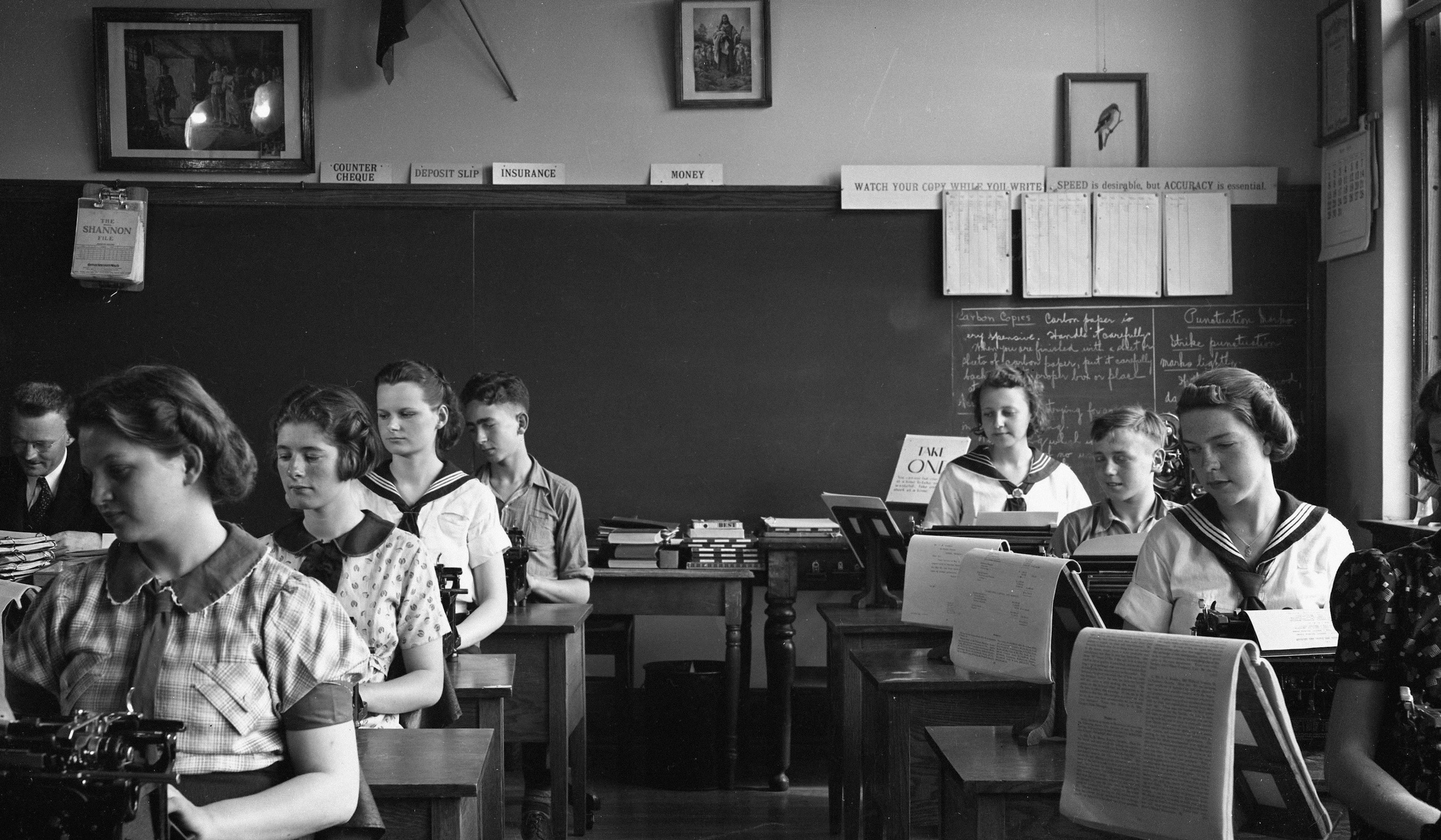
It was 8th grade and typing class was mandatory at Greenfield Middle School in Milwaukee, Wisconsin. If the school administrators had declared they were going to mandate nuclear fusion experiments to be conducted in soda cans it wouldn’t have been a more absurd idea. Big energy in small spaces is a combination that works well for weaponry, not for education. Typing class was too small a space for the teenage chemical experiments that we were at the time.
Sitting at my assigned spot, waiting for the teacher, my legs jiggled in captivity and I glanced up at the clock, hoping that by some miracle we were beyond the first minute of this hour-long class.
Then Mrs. Wagner strode in. Nobody liked Mrs. Wagner—the typing teacher.
At the beginning of every class she’d enter the room with her brown leather valise, set it on her wooden administrative chair, and take up her position at the front of the room in front of her desk. With one hand she’d check the status of her hair bun that was wound so tightly you wanted to maintain a safe distance from it, and then with her reptilian eyes scanning the room, she’d briefly hold each of us in a steely gaze before saying the same thing, every time.
“I know that none of you like me,” she’d say silkily, like it was a good thing. She was clearly proud of her reputation. It was a self-applied performance review delivered with the conviction that things were going beautifully in her class.
“But . . .” she would add, “One day, forty years from now, you’re going to remember me and thank me for teaching you how to type.”
In 1975 I had my sights set on athletics and theater, which made time spent in front of ink ribbons and sticking keys seem impossibly irrelevant to my future. The strikers would routinely clump up with my poor technique and I’d have to pry them apart, leaving telltale stains of incompetence on my fingers.
But it didn’t take 40 years for me to greatly appreciate the skill of typing that I acquired through the insistence of Mrs. Wagner.
I had no way of knowing at the time that my communication and writing skills would be the competency most pivotal to my future professional success; that I’d spend more time in front of a keyboard, recording my words and thoughts, than perhaps any other activity; that when Smith Corona released their first word processor with a tiny digital screen, I’d feel compelled to own one so I could write and print sales letters to get myself booked as an entertainer; that when Zeos released one of the first portable computers in 1991 I would buy one, because any tool that helped me get closer to my ideas and share them with others was one that I needed.
Today I’m still sitting upright, with the appropriate posture to avoid Dowager’s hump, and with typing skills that allow me, more or less, to get my thoughts down at the speed of my thinking.
I don’t think even Mrs. Wagner had any clue how valuable the skill of typing would become. For years I’ve been hoping to run into her on the street somewhere so I could look her in the eye and say . . .
“Thank you. You were absolutely right. I’m so grateful you browbeat me into learning to type.”
I never did see Mrs. Wagner again, but today, fifty-one years later, I’m about to become her.
Right now, you’re sitting in my classroom. The difference is, my class is not mandatory. You can exit with the flick of your finger. So my job is a little harder than the one Mrs. Wagner faced, because if I get heavy-handed, overly-efficient, brusque and demanding, you’ll be on your way.
That’s where stories come in.
Because in this very moment, as you’re starting to drift from reading my last clump of expository, I can tell you about the time that I took my kids for a bike ride in our neighborhood, coasted past the alley of the business block shops, and saw a windblown $100 bill tumbling under my tire.
“Whoa, cool! Kids look,” I said, bending over to pick it up. “I found a hundred dollar bill.”
My son’s response pulling into the alley behind me was the last thing I expected.
“Me too!” he shouted, now holding his own bill and small fortune high.
Looking behind him, there was now a swirl of fifties, twenties, and one-hundred dollar bills skittering across the road. Even more surprising, there were stacks of cash not being blown around because they were still bound in full bundles with a paper strap. There had to be more than a hundred thousand dollars in a 60-foot radius of where we stood.
That’s when I noticed there was purple dye all over most of the money and a policeman appeared around the corner, explaining that the bank on the block had just been robbed and the money dumped here in the alley. As you might expect, we didn’t get to keep the souvenirs we had in hand, but we still have the story.
Notable life experiences bring us the same feeling as free money. You’re instantly excited to be privy to a unique circumstance and a resource you can put in your pocket and use later. What you get to buy with your stories later is attention.
Since stories align with the way humans think, stories help us to galvanize the attention of others on behalf of a communication or an idea. But stories also keep our own hearts awake to the values, principles and futures we’re aiming for. The stories we remember and repeat set the tone and direction of everything we do.
You’ve seen all the headlines from the major business news sources, Harvard Business Review, Fortune Magazine, and countless business gurus and experts. The writing, so to speak, is on the wall.
AI is here to stay and coming for our jobs.
In a Forbes interview with CEO Caitlin MacGregor, the business leader encourages professionals to prioritize durable skills over perishable ones.
“Soft skills are often looked at as a nice to have, not a need to have. And the reality is it’s the durable skills that are the traits and behaviors and abilities that are not specific to one job or industry, but they’re valuable across industries, across roles.”
Citing a list that is mirrored closely by recommendations from the World Economic Forum, MacGregor defines durable skills as:
Complex problem-solving and critical thinking
Adaptability and learning agility
Communication and collaboration
Strategic thinking
Emotional intelligence
As AI absorbs more routine tasks, she asserts, these human capabilities increasingly differentiate top performers.
The capacity to think and communicate in the form of stories is the shade tree under which each of these durable skills flourish. Allow me to coin a term to describe that canopy of refuge.
Storyfluency.
When you’ve re-skilled to be fluent in the language of story, your capacity to engage all of the durable skills listed above surges. Storyfluency is now, without exaggeration, a super-skill.
In short, storyfluency is the new typing.
I’m the new Mrs. Wagner, nagging you to practice and claiming you’re going to look back, maybe closer to 40 days than 40 years, and remember me with gratitude as the person who insisted that you learn to speak the language of story.
We lived on five acres in the Arizona desert the year that my youngest son turned eight. He asked me to plan a scavenger hunt for him and his friends.
When the day came I handed out the clues. There were slips of paper hidden at each successive spot. I stepped into the kitchen to cut carrot sticks and prep the birthday meal, thinking I had about an hour before the kids finished the hunt. But they tore through the first eleven clues in about ten minutes. At that point they came to me and complained that the clue trail had led them to a dead end—a barren plot of rocky ground in the middle of the long field in front of our house.
“That’s no fair,” they moaned. “There’s no prize.”
“Oh, I assure you that there’s a reward,” I said. “Check the clue again and follow where it led you. You’re on the right track, I promise.”
After a few return trips to gripe and my further encouragement to them to keep looking, they realized the final treasure was actually there, buried, two feet down.
What they finally dug up was a cooler that had my son’s ice cream birthday cake in it, only slightly melted, but the story of unearthing an ice cream cake in the middle of the desert is preserved forever.
If you’re looking at your own life like a patch of desert, insisting there’s nothing of note to see, let me help you dig for the treasure. I promise it’s there.
The good news is that personal life review is far more fun, rewarding, enlightening, fulfilling and dynamic than typing, which gives me a good shot at keeping you in my classroom.
If you’re a professional who has had even a passing thought about whether you might lose your job, and you’ve even peripherally entertained the possibility that you might be forced to become a contract worker and need to stand for your expertise, skills or knowledge as a coach, consultant or even leader of your own business, then you can’t afford to skip taking inventory of your life stories.
Your life experiences are proof of your authority, the demonstration of your wisdom and knowledge in the form of what you have lived. It’s time to start gathering those experiences, and learning to place them in legible order, side-by-side, like keystrokes, so you can convey what is in your heart and mind to humans who, for the moment, still respond to authentic expression.
By virtue of the time you have spent on earth, you have some form of expertise the rest of us need. Sharing one’s first-hand experience might be the last job standing in the near future. Robots, it seems, may soon do everything else.
Let’s do the joyful, human job that can’t be done by the robots.
I have an invitation for you.
Just for fun, schedule a time with me to chat for a few minutes and I’ll help you find an amazing story to tell that you didn’t remember you had. No payment required. No strings attached. It’s what I love.


That browbeat line had me lol’ing