The Last Breaths of My First Champion
My grandmother was alive with the holy spirit before she was saved
I pulled the rental into the driveway and left everything in the car so I could proceed directly into the house on the muted, late October day. The New England fall colors had passed and a light fog was settling in over the wide Thames river alongside my grandmother’s home. I was the only thing moving fast, because I wanted to see grandma Betty before she died.
Connecticut was my place of birth and the majority of our relatives still resided there. My father’s teaching work had taken us all over the country in my childhood and now my parents, my brother’s family, and my own had settled in the pacific northwest. Visits to the east coast were rare, but a few months after I turned fifty we received news that Betty, at 96, was suddenly in decline. My mother made her own trip to say goodbye and I happened to have business on the east coast that made it easy to add a visit to see her myself.
My aunt led me through a couple of rooms to a remote corner where my grandmother was sitting. Time has this way of rendering elders translucent, as though gradually introducing the idea of their fading presence. Her thin, pale skin had made the blood vessels clearly visible on her arms and hands, perched on the rests of the high-backed leather chair. Macular degeneration had taken her eyesight years ago, so she was staring at the gray carpet when I rounded the corner, pulled up an ottoman, and tucked my knees in at her side.
“Grandma,” I said quietly. “Hi. It’s Rick.”
She paused, slowly processing the information and the sound of my voice, and then her eyebrows danced almost imperceptibly and her face brightened.
“R-ic-k?
Betty had developed what’s medically called essential tremor in her voice long ago, so when she said my name it sounded like a three-syllable word, but it rang with the tone of clear recognition. We’d been told that she’d lost much of her mental acuity and entire days were passing without intelligible conversation being exchanged, so I was thrilled that she knew it was me.
A window behind her shoulder overlooking the river in Groton, Connecticut showed the fog lifting and the far banks of the adjoining sound came into view. It was a familiar vista I’d enjoyed from my teens when my grandparents had first moved here. With Betty gone it was possible I’d never see it again. I took a deep visual breath of the impression, suddenly seeing the landscape in high definition, like a work of pointillism, every dot of earth-tone color its own private miracle that I wanted to preserve, for me and for grandma at the same time. I took her hand in mine, and she gave it a squeeze with surprising strength.
I’d come for just one reason and I’d arrived in a window of cogency that I didn’t want to miss. The tears welled in my eyes now that I was with the woman who had cared for me as an infant in the first days of my life after my mother had contracted sepsis during my birth.
“You’ve always been there for me grandma. I’m so grateful to have you in my life. I love you with all my heart.”
Her own words required considerable effort, like she was having to turn the crank on an ancient record player, its warped turntable producing a wavy, uneven sound. Even so, Betty’s spirit came through undimmed by the challenges of her vocal equipment.
“I . . . love you . . . too,” she said, with unwavering conviction and warmth.
We sat in silence for a while without a trace of tension or need between us before a few precious memories of her began to surface.
My grandfather had been an enthusiastic drinker in my youth until he found Jesus. Tortured by low self-esteem, which he inherited from a mother who essentially disowned him in the mix of fifteen children, he took to born-again Christianity later in life with a high-intensity fervor. Each time I saw him from around age twelve until his death, he made it clear that I was destined for damnation unless I accepted Jesus as my savior, and that he prayed for me and our whole family every single day.
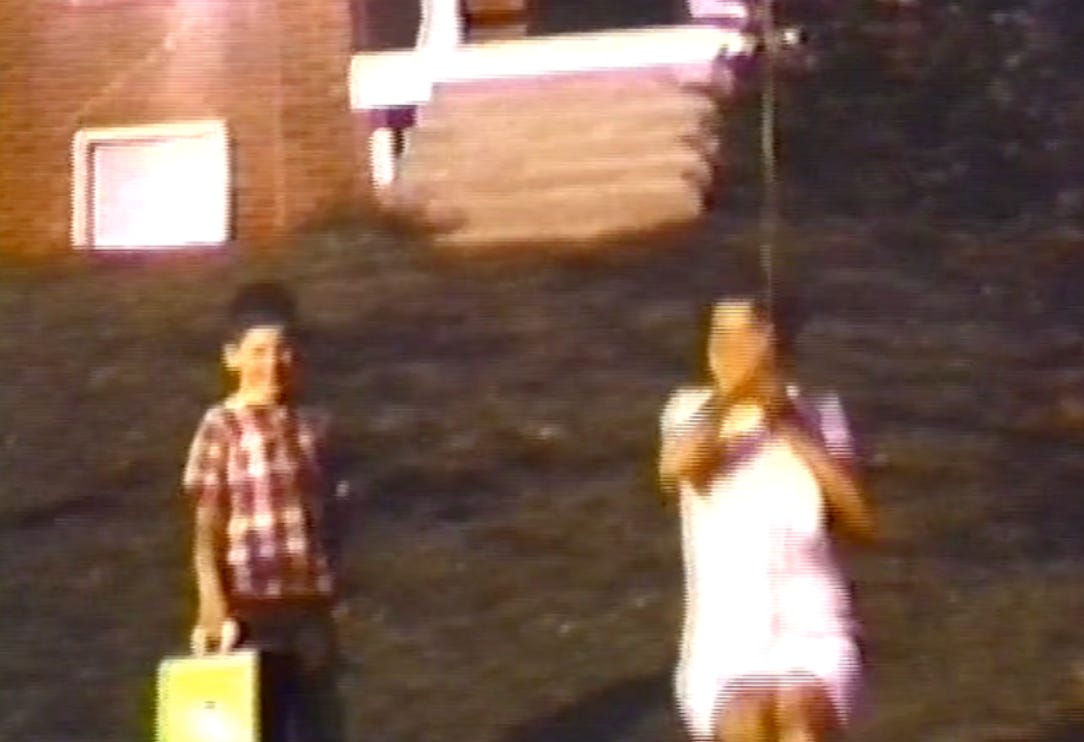
Grandma Betty went with him into the faith, but I never experienced her as being saved. She was whole, radiant, and alive with kindness, generosity and compassion long before giving herself to the Baptist church. In my view, it was her radiant presence in the congregation that redeemed the organization more than the other way around. I’d grown up with a grandmother who’d jump on the swings with me, share cotton candy and a roller coaster ride at the amusement park, laugh easily at her own errors, and eat everyone under the table at Thanksgiving meals.
When I was twenty-one and touring North America with a musical that took us to New England. A short gap between performances in two cities gave me a window of opportunity to see my grandparents.
Betty and I were walking out onto Bluff Point in Groton, overlooking the windswept ocean, the tufts of American beachgrass bent by an incoming gale and I realized my connection to both of them had been eroding like the dunes, because they were born again and I was not.
“The whole religion thing confuses me,” I admitted. “I’ve always felt so close to you and grandpa, but now, it seems like there’s more of a distance.”
Outside of my immediate family, Betty was my person. I’d always felt that she got who I was, and in fact celebrated and respected my joyful and independent spirit. Mutually, I felt I knew her heart, through and through. But I didn’t know if she still felt the same way, having declined to declare myself a sinner in the years since their conversion.
I raised my voice so she could hear me over the stiff wind.
“To me, God is the most forgiving and welcoming force in the universe. And I feel that presence in my life, all the time actually, but I just don’t have any attraction to a punishing vision of God.”
I braced for what my grandmother would say as we kept walking further out onto the bluffs, the sand stinging the few inches of my exposed ankles. But as I finished, she put her hand on my elbow and drew me in close, with that old Betty glint in her eye that I knew from my youth. She locked me in her gaze, pulled her short self up towards my ear, and resolved this conversation between us forever more with a two-word, conspiratorial reply.
“Me too,” she whispered.
I regained awareness of my presence in the sitting room as Betty squeezed my hand again. A cherishing smile turned at the corner of her mouth. She was still staring at the carpet, but her aura was filled with light.
“Do you need anything?” I asked.
She chuckled a little and I wasn’t sure why. Perhaps the idea of having needs at this point amused her, or she may have wondered where the offers to meet her needs were for the last seventy-five years while she’d been putting everyone else first as a nurse, a mother, a wife, a grandparent to a gaggle of grandchildren, and later a congregation of fellow church members. When a person of high integrity gives without complaint, even with palpable joy, it never dawns on us that the apparent ease with which they serve is the result of tremendous inner discipline, a chosen commitment to values, and developed strength of character.
“No,” she said politely, raising a bony hand and resting it affectionately on my arm. “I’m fine.”
Time spun backwards again as I looked at the elegance of her hand.
I was ten years old and we were sitting at the back of a large hall for a Christmas pageant. It might have been Handel’s Messiah, or a similar choral event. I was craning over the heads of the crowd, maybe even standing on a chair at the back of the church to locate my grandmother who I knew was up on stage. I finally spotted her on the right side of the risers, nestled into the third tier alongside the other singers, all of them clad head-to-toe in silver robes with wide flowing sleeves that nearly covered their hands.
I raised my arm in the audience and started waving at her, without any thought to the circumstance she was in or the duties and restrictions she faced as a performer onstage. I was confused when she didn’t wave back as she seemed to be looking straight out at the crowd. Surely she could see my incessantly pendulating hand, and yet, she didn’t respond. Even from that distance, I could see that Betty-bright shine of joy in her eyes. I waved again and again—but she still wasn’t waving back—and I couldn’t fathom why.
“Well . . .” Betty said haltingly, bringing me back again to her side overlooking the river. “I probably won’t see you again.” There was no sadness in this statement of fact, she simply voiced what was clearly true.
“I think I will rest for a while now,” she said, and then gave my hand another squeeze to indicate that she and I were complete. I lingered for a moment longer and stood up to take my leave. There were no final words, no extra goodbye, no more assertions of love—only because there was no need for them.
I left the house and headed back to the car. Grandma Betty died within a week of that visit. It wasn’t until I was driving away that the pageant memory finished itself in my mind.
With undaunted and clueless enthusiasm I continued to wave at my grandmother from the back of the auditorium, hungry for some sort of recognition that she knew I was there, her biggest fan, her devoted grandson who only had eyes for her in that raft of choral members at the front of the room. She was the only rejoicer of god who mattered to me and I wanted her to know it. I was glued to every move of her rising breath, her eyes, and body for any sign that I was in her attention, and then, finally, I saw her slender hand slip down below the cuff of her silver sleeve and she sneaked a brief queen wave that sailed over the heads of the congregation and landed in my waiting heart.
Turning onto the highway I blinked away a blur of tears so I could follow the signs back to Hartford and the airport. Sadness reveals itself in a whole new dimension when deep appreciation for what you’re losing preserves it in you forever—even as you let it go. But there was only one reason that I got to experience that quality of bond with my grandmother. It was the essential, unconditional witness she provided as an elder in my world.
She saw me.
And that’s the only thing that really mattered.
Many thanks to Alden Cox Neha Patel Dana Allen and Clelia Vahni Lewis for their suggestions and edits on this on short notice.


Oh, Rick, Thank you for this piece. Here is the line I most loved: "When a person of high integrity gives without complaint, even with palpable joy, it never dawns on us that the apparent ease with which they serve is the result of tremendous inner discipline, a chosen commitment to values, and developed strength of character." What a beautiful acknowledgment of your grandmother. What a beautiful window of insight into you, as well.
Also I wanted to say, this line is very meaningful to me, as my husband's brother, who I loved very much, just recently passed. I discovered Steve, and Steve's contribution, and presence on the planet in a new way, at the Celebration of Life I just attended in Colorado. So this was very meaningful to me: "Sadness reveals itself in a whole new dimension when deep appreciation for what you’re losing preserves it in you forever—even as you let it go."
Thank you for writing. Thank you for BEING a writer. I am grateful to myself at this time for being a receiver of your gifts from the heart.
Stirring beautiful memories for all of us.