You're Beautiful
A weird thing I did in the Chicago airport one Christmas Eve

I was flying back home from a speaking presentation that I had given the day before to a corporate leadership group. The theme of the conference had been “getting out of your comfort zone.” I’d been hired to present my incompetent waiter routine to help attendees challenge their thinking, but it was my own habits that unexpectedly came into view.
I’d departed from Seattle and had a two-hour layover in Chicago. As we got closer to O’Hare Airport I started to feel queasy, but not because of the flight. It was inner turbulence that was making my stomach flip-flop, anticipating something I knew I had to do, but didn’t want to do.
The presenter who spoke after me at the Seattle conference was a man named Jia Jiang. His claim to fame is a 100-day experiment he conducted called 100 Days of Rejection Therapy. Jia initiated his project as a way to train himself to be less fearful of hearing one simple word.
No.
The social experiment involved making crazy requests of strangers to get more comfortable with accepting rejection.
To Jia’s surprise, however, he received an extraordinary string of permissions. He got clearance to slide down a firehouse pole, get his hair trimmed by a dog groomer at PetSmart, and make a public announcement on a Southwest Airlines flight — along with many other unusual privileges that were granted to him just because he asked.
After hearing Jia’s story and meeting him, I realized that I had become quite comfortable in a finite area of risk. My bad waiter routine is universally seen as a brave spectacle, but outside of that context, I wasn’t putting myself in circumstances that challenged my comfort zone very often. I’d taken all sorts of risks when I was younger, like working my way up to riding a 12-foot unicycle as a street performer, but I’d lost some of my adventuring edge in later years and Jia reminded me of its value.
Sitting on that first flight to Chicago, what popped into my mind was a simple idea to challenge my usual routine. Since it was Christmas Eve, I imagined spending my time on the layover telling random strangers that they were beautiful and wishing them a happy holiday.
It would be a harmless experiment since I wouldn’t be asking anything from anyone. But the more I thought about it, the more I realized how awkward it could be to make this communication in the middle of a busy, cavernous airport where everyone was rushing home for the holidays. Might people question my intent? I’d certainly get some strange looks. At the least, I needed to be prepared for being ignored. And what if someone at the airport told me to stop?
The more I considered the challenge, the more questions arose. Where would I do this? How would people react? Did I really have the courage?
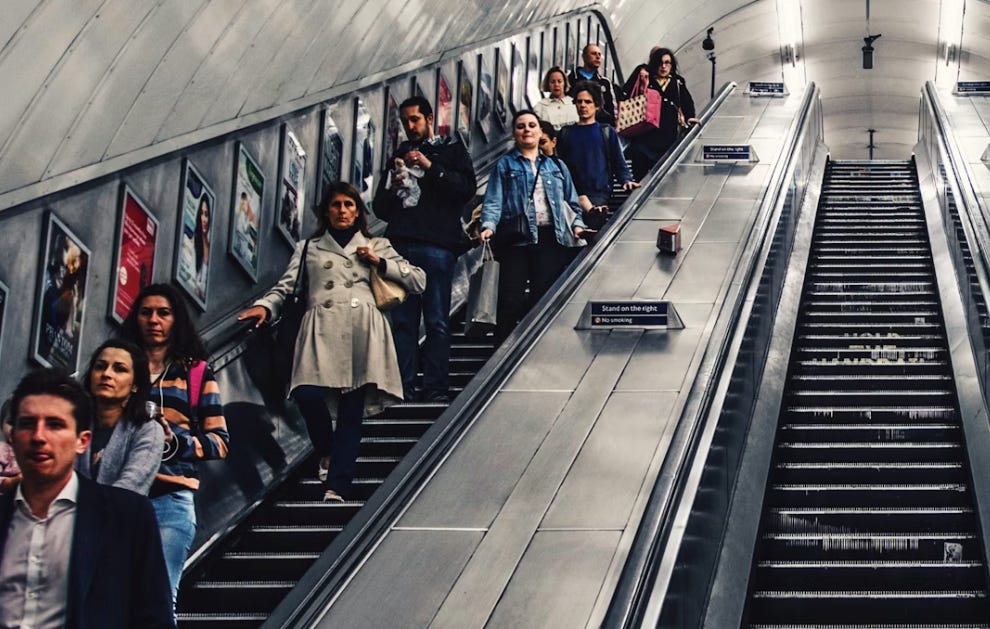
After getting off the plane I made my way to my connecting terminal so I wouldn’t have to worry about catching my next flight and then started thinking practically about how to follow through with the idea. I looked around for a place where people would be forced to walk past me and decided that an escalator going down to baggage claim would be a perfect spot to address people one-by-one. I’d stand at the bottom and tell people they were beautiful and wish them a happy holiday as they stepped off.
I pulled out my notebook and wrote “You’re Beautiful—Happy Holidays” in big letters on a piece of paper thinking it could help me break the ice with people. That’s when my anxiety really kicked in, because the idea was now real and I was about to put myself on the line.
I walked over to the base of the tall escalator and looked up. It was eerily quiet. Just as I was considering putting my sign away and ditching the idea, a few people stepped on at the top.
My heart was pounding as the passengers drifted down toward me.
A businessman with one hard side carry-on had squeezed past two others and was speeding his descent by walking down the escalator at a clip. I watched the metallic teeth of each escalator tread hypnotically roll to the base of the escalator and disappear into the floor, wishing I could do the same. I stood there holding the sign as the echo of overly loud announcements boomed over the PA and bounced off the walls. I braced to see how this man was going to react. I was standing right there in front of him with a sign that said “You’re Beautiful.”
He rushed by, completely ignoring me.
My cheeks turned bright red and I took his dismissal as confirmation that I shouldn’t be doing this, that it was weird and awkward. The other riders were now getting closer and it took a great force of will to stay in place.
Finally reaching me at the bottom, these travelers ignored me too, except for one of them who read the sign, but exhibited no reaction.
The squirmy feeling I had inside was relieved once these people were gone, but I was also disappointed I hadn’t followed through with saying the words out loud that I’d written on the sign. Clearly, the sign alone wasn’t going to do the job.
I stood alone for a few more minutes, just me and the swish-swish of the shiny escalator stairs passing by and the question, “What the heck am I doing?” in my head. Hearing voices I looked up and suddenly a crush of travelers appeared at the top. A few flights must have recently arrived and they crowded onto the escalator all at once.
Again, I wanted to bolt, and I could feel it as a turning point. If I didn’t fully commit to doing this now it would never happen. I knew the disappointment of backing away from the challenge would be way worse than the discomfort of following through, so I made a decision, and accepted it was going to feel weird. The moment I made that decision the fear that I couldn’t handle the situation turned into the confidence that I could.
The first to reach me in the wave of travelers was a friendly looking couple. One of them had an open shopping bag with a few wrapped presents sticking out of it. I was emboldened by the fact they were celebrating the holidays and I heard myself say the words:
“You’re Beautiful. Don’t forget it. Happy Holidays.”
It was a bit of an out of body experience, but both of them looked up, smiled, and the man replied with, “Thank you very much. Happy Holidays to you as well.”
That single, generous response was all I needed. I suddenly felt that I could happily stand there all night and it would have been worth it, even if it were only this one person who received my message.
In the end, I told hundreds of people they were beautiful.
Honestly the words felt foreign and contrived at first. Did I really think each of these people were beautiful? Before delivering the words, the answer was no. But the miraculous thing was how beautiful people became once I said the words out loud. A haggard elderly woman who I imagined might take a swing at me with her handbag when I told her she was beautiful transformed before my eyes. Every furrow in her wrinkled face reorganized itself into an etching of joy—as though a cloud had lifted off of the mountain of her experience. She straightened up, put out her cane to steady herself for the first step off the escalator, and said, “Good gosh! You’ve just made my day!”
As I allowed the words to escape my lips while looking at this wide cross-section of humanity—young, old, large, small, all genders, shapes, colors, and moods of people—I actually started to experience that people indeed possess tremendous beauty. All of them unique and intriguing and amazing, as though each person was shielding and masking the radiance of their essence until it was named.
I recently saw a quote from a meditation teacher, Barbara Dubois, who said, “When you love someone, something, anything, it becomes lovable.” My experience showed me this was completely true.
I had to fake it, but then I made it—falling into the lap of humanity’s spectacular diversity. And the more I saw and felt the beauty of individuals the more openly people started responding to me.
“Thank you so much!” “That is so kind.” “What an incredibly sweet thing to say,” were the types of comments that were made, along with the wish for me to have a happy holiday in return.
I reached the moment when I thought I was done, but then decided to go a few minutes more, just to send a final message to my brain about the presence of discomfort and assert that I would decide when I’m done, not my inner comfort machine.
Shortly after, two women boarded the top of the escalator and saw me standing at the bottom and heard me greeting the arriving passengers. Halfway down the escalator one of them burst into appreciation and shouted out, “You’re Beautiful,” and pointed straight at me, like she wanted to make sure I didn’t try to dodge my own place in the parade of human beauty. She beamed at me all the way down, leaving me full with the sense of having given and received something of enormous value in the act of setting my comfort aside in favor of this feast of connection.
And that brings us to you.
As a subscriber you’re a traveler who keeps passing by, riding down my escalator repeatedly, even though you know I’m going to be standing there probably doing something weird at the bottom.
I’m grateful that you allow me to share my stories with you, and that you receive them, never once threatening me with your handbag.
We’re all in this human thing together and your presence here is not taken for granted.
You’re Beautiful.
Happy Holidays.


Rick, THIS reflection of yours today is so beautiful.
And this so profound: “Did I really think each of these people were beautiful? Before delivering the words, the answer was no. But the miraculous thing was how beautiful people became once I said the words out loud.”
What we see comes from how we look.
Thank you, pal. 🙏
Rick,
This piece does something profound: it argues, with gentle, awkward courage, that what binds us together is infinitely greater than what keeps us apart.
You stood at the bottom of that escalator and proved it. You embraced the one thing we fear more than rejection: the risk of looking stupid in the service of a simple, human truth. That terrifying vulnerability wasn't a side effect; it was the proof of concept. It was the cost of admission back into our shared humanity.
We've become aliens to the very connection that defines us. We trade glances for screens, acknowledgements for efficiency. You didn't just break a social rule. You performed a repatriation. You walked into the no-man's-land of public anonymity and planted a flag of recognition so basic—"You are beautiful, you exist, I see you"—that it forced a ceasefire in the silent war of separateness we're all fighting.
That's why the woman with the cane straightened up. That's why the radiance appeared. You weren't just naming beauty; you were reconnecting a severed circuit. The current that flowed wasn't just kindness; it was the shock of belonging, the voltage of "we."
So thank you. This isn't just a story about comfort zones. It's evidence. It's proof that the glue still holds, that the binding agent of our common humanity is still potent—but it requires someone brave enough to look foolish applying it.
You didn't just tell strangers they were beautiful. You performed a public, quiet ceremony of reconnection in an airport, and you gave people back to themselves. And in doing so, you gave us all back to each other.