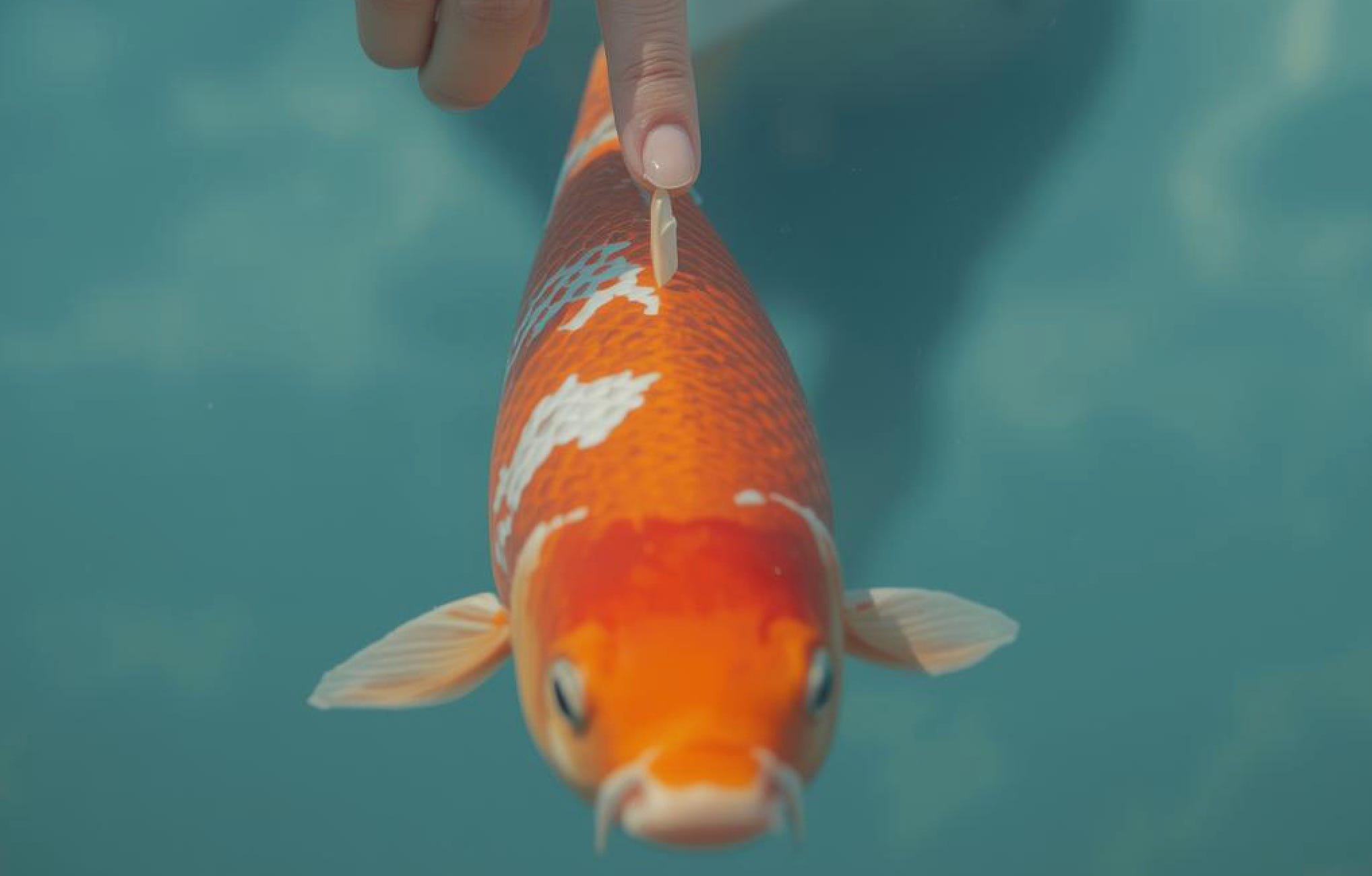
Poke the Fish
Are you hesitant to touch your past?
I was supposed to be leading a scheduled Zoom session, but I took a last minute trip to Kenya instead. Not in real life, but in my imagination.
Several times a week we come together in our writing community1 to discuss writing ideas and personal experiences that might be worth sharing. A good measure of what our members write only gets published because the group reflects back the significance of a story, comment or idea that the author has overlooked.
It’s a common occurrence that we don’t see the value of our own life experiences. When brought to our group conversations we often discover that our history contains gifts we’ve rushed by or abandoned in our past.
, one of our members, was feeling guilty about coming to our regular session without something to share. Another participant had just related an experience highlighting the importance of play—quoting a mentor who’d once suggested that she “pay attention to whoever is having fun.”Neha’s brows suddenly rose in revelation and her brown eyes sparkled with a combination of mischief and delight.
“Ooo, that reminds me of a story,” she said.
This is often the case in our Story Gyms. Attendees can arrive thinking they have nothing to contribute, but they never walk away with the same conviction, because human experience is akin to the root system of a forest. Like trees, we appear to be independent organisms, but we share an unseen network of connections that soften our autonomy. A comment from one person often leads to a story from another.
That’s when Neha took us to southern Kenya.
A cancelled train trip forced Neha’s family to make a last-minute, eight-hour trek by taxi service on a bumpy dirt road through a game reserve where they struggled to catch some rest in a sweaty backseat pile.
She’d traveled with her parents, aunt, uncle and brother from the UK to see her dad’s place of birth, but their enthusiasm dimmed with each warning from locals about places to avoid and the abundant cautions they should take. They were a close clan, but the confinement and hours of jostling had put a dent in the family spirit.
Finally, they arrived damp and ragged at the door of their hotel, ready to get settled and take refuge from the oppressive heat. But the lobby was in chaos. Half the world, it seemed, was trying to check in. Elderly travelers clung to counters, parents scrambled after plush toys being flung from toddler prams, older children ran dizzy circles through the throng, and above it all, a series of defunct ceiling fans mocked the crowd, motionless, except for one lone set of blades that spun ineffectively above the humid atrium.
At twenty-seven years old, Neha’s older brother Jay was the most able-bodied of the family, shouldering most of the responsibility for the group’s luggage with Neha pitching in. The stress of keeping track of it, moving it, and attempting to get the attention of a sincere yet overwhelmed receptionist was knit into Jay’s brow, and his patience was wearing thin. Despite the usual residual tensions between adult siblings, Neha felt the burden of her brother’s role and the desire to lighten it if she could.
Scanning the lobby, her eyes fell upon the lush potted plants that were grouped in clusters. She would have dismissed them as fake, but proximity to the equator made flora of this size possible. Beyond the plants, the laughter of a child caught her ear, and following the giggles she noticed for the first time, a fountain.
Strolling over Neha was delighted to discover . . . fish.
An orange and white ornamental carp lazily paddled against the current of the circulating lagoon.
Neha returned to the check-in line with a new mood, though the queue hadn’t moved an inch. She heard her brother ask the receptionist through gritted teeth when they could expect to have their rooms.
Neha came alongside him and rested a hand lightly on his arm.
“There’s a koi pond,” she said.
“Oh?” he replied, trying to look interested, but too stressed to care.
Suddenly an old mischief, exported from childhood, took hold of Neha’s demeanor and she leaned into its invitation.
“Come on. I dare you to touch one.”
He looked at her blankly, waiting for Neha to laugh, give up the joke, and resume the adult responsibilities at hand. But she repeated herself—a little sister again—daring her big brother to do something delightfully stupid.
“Come on. I dare you.”
He gave her a side eye, but a hint of mirth twisted at the corner of his mouth.
“Okay fine, but you have to do it first,” he said.
Following her to the pond, Jay bent skeptically over the water.
“There aren’t even any fish in there,” he said, straightening up and looking relieved, but she doubled-down.
“Look closely man, they’re there. They’re koi. Look at the big orange one!”
Adjusting his eyes to the dappled water he could now see the fish drifting and darting below the surface.
“Well?” she teased. “You have to touch one.”
“You first,” he countered. “Then I might consider it.”
Neha looked at the pool and then glanced toward the desk to see who might be watching, suddenly feeling guilty of mischief in advance.
“Who touches a random fish?” she thought to herself. “In a hotel pond? Wouldn’t it feel weird?”
She’d always imagined it would feel slimy, but now she was being challenged to swap imagination for direct experience. As she gathered her nerve, her dad walked over.
“What are you two doing?” her father asked.
“Dad, Neha’s gonna touch a fish,” Jay announced.
Neha looked back at her father sheepishly and he grinned with amusement.
“Go on then,” he said, making a gesture towards the big orange one.
But while she hesitated, her father’s curiosity got the better of him. He bent down and put his own hand gently in the water. A small fish swam under his fingertips, and he gave a soft stroke to a shimmering white koi.
The surface tension of this strange idea was now broken. Neha and Jay also moved their hands toward the pool, their adventuring fingers extending into the refreshing water and then dancing with the day glow fish, which were not slimy at all, but soft, cool, and docile in response to their touch.
Neha concluded her story in the aura of our rapt attention, our mirror neurons having been taken hostage in the symbiotic charm of storytelling.
“Suddenly the sweat on my clothes, the weight of my backpack, the stairs and the suitcases we had to carry to the top of them - none of it mattered,” she explained. “I spent the rest of the day marveling at the fact that I’d just glitched my own matrix, and that of my family, on purpose.”
As she finished her tale I regained awareness of where I was: on a Zoom call, not leaning over a koi pond, tropical plants draped over its edges, envisioning Neha and her family playfully poking fish.
In the same way I’d been transported to a new world, Neha brought a playful dare to an interminable day and transformed her family’s experience by shifting the spotlight of their attention to a subject of delight.
The story itself was an independent joy, but where it led in our conversation was even better.
Neha, a recently certified coach, describes her own writing as a quest to capture moments after which everything is different. I saw her story as technicolor evidence of her capacity to find transformation in an ordinary corner of experience. It was a perfect origin story, demonstrating the natural authority she bears for the role of life coach.
“This is exactly why your decision to become a personal coach is so fitting,” I remarked. “Your story is proof of your keen eye for transformative action. Now you’re making a career of coaching others to poke their own fish.”
Neha herself hadn’t seen the connection until that moment.
“Whoa. This is blowing my mind,” she exclaimed.
This is a recurring dynamic in our sessions, where a shared story reveals something of our essence, and the group sees the dazzling fish in our water before we do.
Storytelling, coaching, and conversation in a bonded community all bring a shared benefit. They help humans to notice and redirect their attention toward what matters most.
The details of our simple experience contain universal wisdom. Koi pond moments hold enduring truths. A promise, a breeze, a smile, an uttered “yes” changes the direction in our lives. But life happens so fast it’s hard to fully unpack those insights in the moment they arise. We’ve calibrated our nervous systems just to make it through the day, not to access life’s refined and nuanced instruction. Storytelling and life review makes the common phrase “you had to be there” accessible retroactively. We can go back and smell the flowers we walked right past yesterday.
Neha’s commitment to our story practice, even when she thought she had nothing to share, proved that an examined life is worth living.
But as I encourage others to embrace and share their own stories in my role as a writing and storytelling coach, I hear the same protests again and again.
“I don’t have any good stories to share.”
”I don’t want my writing to be all about me.”
”Nobody wants to hear my stories.”
Talking about ourselves feels taboo and threatening, like poking what we imagine will be a slimy, perhaps even hostile fish. So we try to forget our own past and move on to more important things.
But we’re ignoring something critically important in our speed-ahead, leave-the-past-behind culture—the full impact of transformative experiences. An impact that can only occur when we accept that we have stories to tell. When we see the wide eyes, tears, and smiles of others in response to what we share, we see our own stories in a new light. They suddenly reveal who we’ve always been and clarify the future choices that will align us with our heart.
Great storytelling is not about tips and tricks for delivering them. It’s about authenticity, courage and curiosity. It’s about learning to look a little longer at the dark water of our history until we see the color that is moving beneath its surface.
I invite you to set aside the belief that you have no good stories to tell.
, another member of our writing group, describes his story journey in a recent reply to a comment I left on one of his latest essays.In the last year Larry has created a network of connection for himself through his storytelling. His last published essay generated a burst of appreciation, conversation and reflection from a community of readers and authors.2
Even Larry’s sister, who follows his writing, chimed in with unprompted testimony to what Larry’s year of storytelling practice has produced.
, also in our writing group, recently told us about an encounter with an animal trainer who stepped in with a confining assessment of her therapy dog. In the past, she explained, she likely would have acquiesced to the opinion of an expert, even though she’s an authority in the field herself. But a year of personal storytelling armed Genie with a new awareness of an old pattern. Instead of backing down, she claimed the opportunity to stand as an advocate for her dog Harry. expressed her effusive appreciation for our story sharing practice after a session sparked an early life experience that she wrote about in her publication.“Honestly, if someone told me that $10,000 was the price of admission I would just pay it, no questions asked.”
That might seem like an exaggerated statement, but less so once you’ve read her essay3 and see how community sharing can lead to recovering pieces of our soul and rising again with our purpose and sense of clarity and dignity restored.
The divine is contained in the details of what happens and what doesn’t happen. Where a bird flies, and a seed lands. How the lingering smell of chocolate and beer in a car that carried your father in his final days will never leave your mind.4
When we let our story out, like a thunderbolt crackling from a cloud to the ground, an electric current fills each listener with the holy breath of manifest life—the wet leaves, the last kiss, the missed shot, the mother’s disappointment, the kitten we fed with an eyedropper.
Your stories are both holy and they will make you whole—restoring parts of yourself you thought were irretrievable. When you share them, you retrieve us with you. Then a conversation that matters can truly begin. Heart to heart. Story to story.
Are you ready?
The extraordinarily ordinary life you have lived is waiting.
Let’s go poke a fish.
I’m considering writing a book next year focused on helping anyone who wants to be a more confident storyteller.
It would include step-by-step support for:
Recalling and building an inventory of one’s most compelling life stories.
Cataloguing and organizing stories for writing a memoir.
Learning how to use personal experiences in marketing, leadership and sales.
Tailoring stories for public speaking.
Using personal stories for developing the backstory of fiction characters.
And how to make non-fiction writing projects more relatable and engaging by including one’s personal experiences.
Much gratitude for ’s supply of this story, help with edits, along with feedback from and from our Write Hearted tribe.
published her own version of her Poke a Fish story as well. It’s here if you’d like to read it.
Write Hearted writing community.
Kate Thomson, Cruelty and Grace


Rick,
This is a beautiful and vital model you’ve built. The image of the "koi pond moment" as a glitch in the matrix—a deliberate, playful pivot from frustration to shared wonder—is a perfect metaphor for the transformation that real storytelling can trigger.
You've put your finger on the exact alchemy: a bonded community reflecting back the significance we've overlooked in our own lives. Your question about whether we're hesitant to touch our past is the crucial one.
It makes me think of my own father. For years after my mother died, he carried her passport in his briefcase. It wasn't a document for travel; it was proof. Proof that she had been here, that their shared journey was real. He was a man of immense resilience, but his deepest story was one of devotion: caring for her, night and day, as she died, showing me that love is not a feeling but a daily, gruelling, glorious choice to stay.
I realised, much later, that my entire understanding of character—of what holds us in the dark—was forged in watching him. I had been living the answer to your question long before I could articulate it. We are not just hesitant to touch our past; we often fail to see that we are living its continuous, unfolding lesson.
Your ‘Story Gym’ creates the sacred space where that realisation can take hold. It’s where we see that the fish in our own dark water are not slimy fears, but the shimmering, overlooked truths of who we have always been.
Thank you for this profound work.
Fabulous post. Community is a game-changer with writing as with other human endeavors.
I wholeheartedly vote that you should write your book. Your decades of accumulated, real-time knowledge and expertise in the art of story-telling practically write the book for you.